Politics
INTERIOR MINISTER LAURENT NUNEZ EMPHASIZES JOINT ACTION ON SECURITY & MIGRATION
IN ADDRESS AT MINISTRY OF FOREIGN AFFAIR
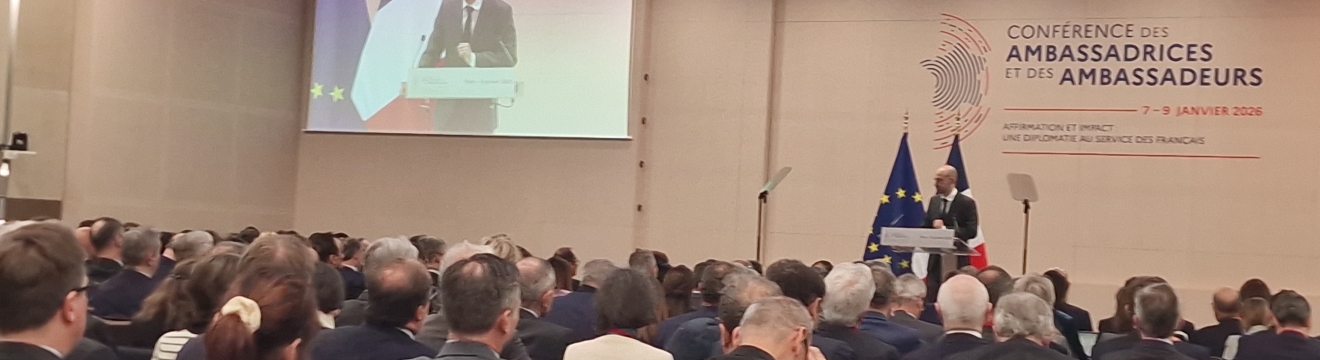
Interior Minister & MFA L.Nunez & JN Barrot (Source: Rahma Sophia Rachdi, Jedi Foster)

Interior Minister & MFA L.Nunez & JN Barrot
(Source: Rahma Sophia rachdi Jedi Foster)
(Source: Rahma Sophia rachdi Jedi Foster)
“The last time, you ambassadors, met with the prefects, it was at Place Beauvau, at the interior Ministry. I am delighted today to welcome Minister Laurent Nunez here at the Ministry of Foreign Affairs extended to him” “The very best wishes for 2026” and praised “The quality of the cooperation that unites our two sovereign ministries? MFA Jean Noel Barrot said to his guest Minister Laurent Nunez. Source (Rahma Rachdi, our correspondent, reported on site, Gutenberg building, Paris 15th)
LAURENT NUNEZ, A HIGH-RANKING CIVIL SERVANT TURNED INTERIOR MINISTER
According to his official biography, Laurent Nunez, born in 1964 in Bourges, is a career senior civil servant who has spent most of his professional life within the Interior Ministry. He has served as director general of the internal security service (DGSI), Secretary of State to the Interior Minister, national coordinator for intelligence and counter terrorism at the Elysée, and Prefect of Police of Paris before being appointed Minister of the Interior in October 2025. This trajectory, from prefectural posts to intelligence leadership, explains the central role he now claims in coordinating internal and external security policy.
According to his official biography, Laurent Nunez, born in 1964 in Bourges, is a career senior civil servant who has spent most of his professional life within the Interior Ministry. He has served as director general of the internal security service (DGSI), Secretary of State to the Interior Minister, national coordinator for intelligence and counter terrorism at the Elysée, and Prefect of Police of Paris before being appointed Minister of the Interior in October 2025. This trajectory, from prefectural posts to intelligence leadership, explains the central role he now claims in coordinating internal and external security policy.
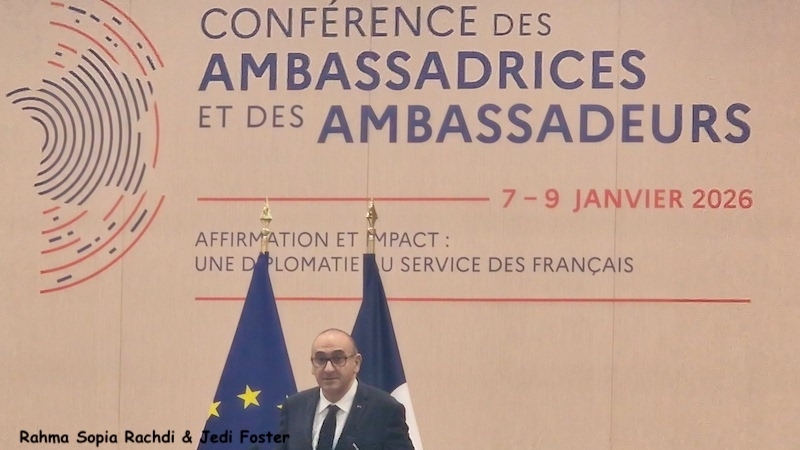
Interior Minister & MFA L.Nunez & JN Barrot
Source: Rahma Sophia Rachdi, Jedi Foster
Source: Rahma Sophia Rachdi, Jedi Foster
INTRODUCTION: AMBASSADORS AS DECISIVE ALLIES OF INTERNAL SECURITY
Minister Nunes begins by thanking the organisers for having included the Interior Ministry in the Conference of Ambassadors, recalling that his previous intervention in this format dated back to 2018 when he was secretary general of the ministry. He explains that this allows him “to revisit our common internal and external interests through the functioning of borders” and stresses how closely connected internal security and diplomacy have become.
Minister Nunes begins by thanking the organisers for having included the Interior Ministry in the Conference of Ambassadors, recalling that his previous intervention in this format dated back to 2018 when he was secretary general of the ministry. He explains that this allows him “to revisit our common internal and external interests through the functioning of borders” and stresses how closely connected internal security and diplomacy have become.
Interior Minister Nunez then underlines the exceptional density of the Interior Ministry’s external network: with. “175 networks covered”, he describes it as “the densest in the world” in the fight against crime and migratory flows, dedicated to the protection of civil society. Ambassadors, in his words, are “very direct contributors” and therefore “decisive allies” of the Interior Ministry, fully integrated into the chain of protection that extends beyond France’s borders.
A EURPOEAN AND INTERNATIONAL STRATEGY IN THREE AXES
The Interior minister Laurent Nunez, warmly thanks the Director General of Internal Security, the heads of the National Police and Gendarmerie, and the Director General of Civil Security, whose presence signals the growing international dimension of their missions. He stresses that “our ministry is involved at the highest levels of European and international action”, and that this action is now a key lever in France’s overall security. Minister Nunez explains that the Interior Ministry’s European and international strategy rests on three main axes, articulated with the diplomatic service.
The Interior minister Laurent Nunez, warmly thanks the Director General of Internal Security, the heads of the National Police and Gendarmerie, and the Director General of Civil Security, whose presence signals the growing international dimension of their missions. He stresses that “our ministry is involved at the highest levels of European and international action”, and that this action is now a key lever in France’s overall security. Minister Nunez explains that the Interior Ministry’s European and international strategy rests on three main axes, articulated with the diplomatic service.
The first relates to civil protection and European solidarity, where he cites concrete examples such as the EU’s response to the “Chino” cyclone and, more recently, the Crans Montana cable car disaster in Switzerland, to illustrate how French security services work hand in hand with European partners in major crisis.
DATA ACCESS, INTELLIGENCE & THE STRATEGIC ROLE OF AMBASSADORS
Second axis concerns access to data, which the minister describes as a “very delicate subject” but a “crucial issue for the intelligence services”. He notes that discussions in Brussels are “difficult” because they touch on sensitive fundamental rights, yet insists that secure access to data is essential for anticipating threats, dismantling criminal networks and countering terrorism.
Second axis concerns access to data, which the minister describes as a “very delicate subject” but a “crucial issue for the intelligence services”. He notes that discussions in Brussels are “difficult” because they touch on sensitive fundamental rights, yet insists that secure access to data is essential for anticipating threats, dismantling criminal networks and countering terrorism.
In this context, he underlines that ambassadors provide “a fine and strategic position” in diplomacy on these subjects, helping to reconcile the protection of freedoms with operational imperatives. By bringing their understanding of partner countries and European negotiations, they contribute to shaping balanced compromises on data, surveillance and information sharing that are acceptable both politically and legally.
Interior Ministry Nunez explains that consolidating action at the European and international levels will also help to “make French security expertise radiate”, producing effects not only overseas but also on the national territory and in the overseas departments and territories. The minister insists on using the full “technical palette” of the Interior Ministry, in particular CIVIPOL, which he describes as a key operational tool that “will continue to play its role” in supporting partner states and structuring cooperation projects.
Third axis of his strategy concerns international cooperation on migration. Interior Minister Nunez speaks of “strengthening borders abroad” and “redirecting smugglers and passeurs,” making it clear that the aim is to act upstream, outside French territory, rather than only at the national border. He insists that these subjects are “at the heart of our actions” and must be treated as genuine strategic priorities for the Interior Ministry.
NEW POSTS & REINFoRCED NETWORKS AGAINST NARCOTRAFFICKING & IRREGULAR MIGRATION
Looking ahead to 2026, Laurent Nunez announces an ambitious strengthening of the Interior Ministry’s external network. He mentions “seven new posts” to be created, including in Ecuador, the United Arab Emirates and Peru, which will be dedicated in particular to the fight against narcotrafficking. He also highlights the creation of a Franco Colombian team and new liaison posts specializing in migration issues, such as the one recently opened in Herville.
Looking ahead to 2026, Laurent Nunez announces an ambitious strengthening of the Interior Ministry’s external network. He mentions “seven new posts” to be created, including in Ecuador, the United Arab Emirates and Peru, which will be dedicated in particular to the fight against narcotrafficking. He also highlights the creation of a Franco Colombian team and new liaison posts specializing in migration issues, such as the one recently opened in Herville.
These reinforcements will increase the number of experts deployed from “35 to 50”, a substantial rise that should make it possible to better monitor migration routes, influence visa policies and adapt to the constantly evolving strategies of smugglers and drug traffickers. The minister indicates that a roadmap on visas and mobility is being finalized and that a document will be published within two weeks, outlining, among other things, the 22% increase in forced returns recorded in 2025.
WORKING HAND IN HAND WITH PREFECTS, CONSULATES & EUROPEAN PARTNERS
Minister Laurent Nunez insists on the “cooperation of our prefects and consulates” and thanks the diplomats present for the support they provide in implementing returns and migration policies on the ground. He points out that joint operations have already been conducted with three partner countries in the past year and mentions future projects with states in the Great Lakes region of Africa, where migration and security issues are closely intertwined.
Minster Nunez refers to the forthcoming entry into force of the European Pact on Migration, expected in June, which should enable “more efficient migration policy” at EU level. The minister invites ambassadors “to nourish our correspondence” and not to consider reception conditions for migrants in France in isolation from what neighboring states are doing, but rather in the broader framework of a European and global migration architecture built with the European Union and the United Kingdom.
Minister Laurent Nunez insists on the “cooperation of our prefects and consulates” and thanks the diplomats present for the support they provide in implementing returns and migration policies on the ground. He points out that joint operations have already been conducted with three partner countries in the past year and mentions future projects with states in the Great Lakes region of Africa, where migration and security issues are closely intertwined.
Minster Nunez refers to the forthcoming entry into force of the European Pact on Migration, expected in June, which should enable “more efficient migration policy” at EU level. The minister invites ambassadors “to nourish our correspondence” and not to consider reception conditions for migrants in France in isolation from what neighboring states are doing, but rather in the broader framework of a European and global migration architecture built with the European Union and the United Kingdom.
A UNITED FROTN AGAINST NARCOTRAFFICKING & VIOLENCE
In his conclusion, Laurent Nunez thanks Jean Noel Barrot for his approach and “the operational mindset” that now characterizes the relationship between the Foreign Affairs and Interior ministries. He stresses that the fight against narcotrafficking a scourge coming largely from Latin America and now affecting all parts of France, from urban peripheries to rural areas requires “bilateral relations” and a sustained effort in the Caribbean and along all drug routes.
In his conclusion, Laurent Nunez thanks Jean Noel Barrot for his approach and “the operational mindset” that now characterizes the relationship between the Foreign Affairs and Interior ministries. He stresses that the fight against narcotrafficking a scourge coming largely from Latin America and now affecting all parts of France, from urban peripheries to rural areas requires “bilateral relations” and a sustained effort in the Caribbean and along all drug routes.
Minister Laurent Nunez calls for “joint mobilization in 2026” of ambassadors, security services and all the Interior Ministry networks to protect French society against the spread of drug related violence, gang wars and all forms of criminality, from street violence to domestic abuse. By strengthening the link between diplomacy and internal security, Minister Laurent Nunez presents this speech at the Quai d’Orsay as a strong, encouraging and enthusiastic signal of a common determination to continue working together to safeguard France’s security, both within its borders and beyond. Source (Rahma Rachdi, our correspondent, reported on site, Gutenberg building, Paris 15th)
Liability for this article lies with the author, who also holds the copyright. Editorial content from USPA may be quoted on other websites as long as the quote comprises no more than 5% of the entire text, is marked as such and the source is named (via hyperlink).