
Politics
IRAN STRIKES & THE DEATH OF KHAMENEI: MACRON CONVENES A SECOND DEFENCE COUNCIL
IRANIAN STRIKES ON ISRAEL AND GULF BASES
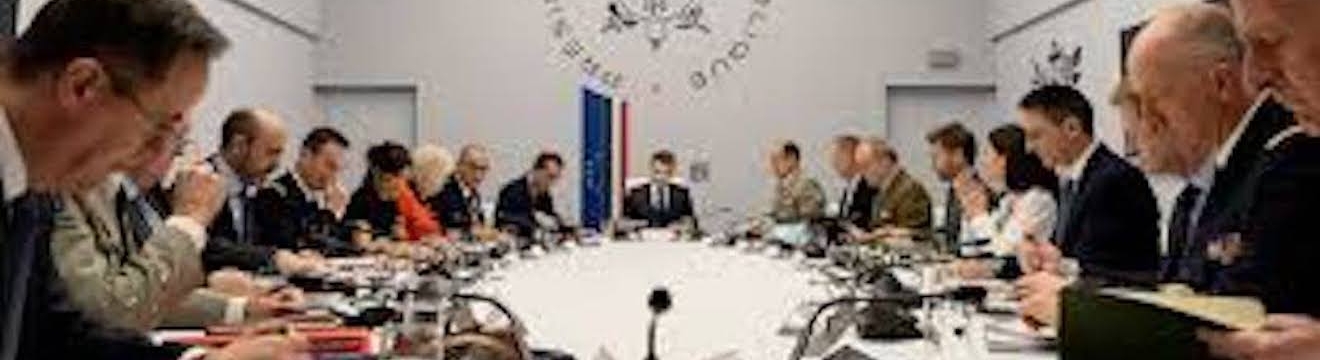
Council of Defence & Security, French Presidency/E (Source: French Presidency/Elysee)
USPA NEWS -
IRANIAN STRIKES ON ISRAEL AND GULF BASES INCLUDING DUBAI (UAE), BAHREIN, OMAN, KUWAIT, BAHREIN
On the evening of 1 March 2026, the Elysee once again turned into a war room. Less than twenty four hours after his first Defence and National Security Council on Iran, President Emmanuel Macron has summoned ministers and senior military commanders for a second emergency meeting at 7 p.m., against the backdrop of an ever widening confrontation between the United States, Israel and the Islamic Republic. Since Saturday’s joint “Epic Fury” operation, which killed Iran’s Supreme Leader Ali Khamenei and struck dozens of strategic targets, Tehran has vowed revenge and has begun to deliver it with volleys of missiles and drones against Israel and a string of American and allied bases across the Gulf, including, Bahrein, Qatar, UAE ( (Palm's Fairmont,Airport, Dubai symbol of largets melting pot of 190 foreign citizenships from all over the world), Kuweit, Bahrein, Oman. This is an editorial, not on the ground reporting. It reflects the independent analysis of our handy journalist and relies on officially available French information and verified public statements.
On the evening of 1 March 2026, the Elysee once again turned into a war room. Less than twenty four hours after his first Defence and National Security Council on Iran, President Emmanuel Macron has summoned ministers and senior military commanders for a second emergency meeting at 7 p.m., against the backdrop of an ever widening confrontation between the United States, Israel and the Islamic Republic. Since Saturday’s joint “Epic Fury” operation, which killed Iran’s Supreme Leader Ali Khamenei and struck dozens of strategic targets, Tehran has vowed revenge and has begun to deliver it with volleys of missiles and drones against Israel and a string of American and allied bases across the Gulf, including, Bahrein, Qatar, UAE ( (Palm's Fairmont,Airport, Dubai symbol of largets melting pot of 190 foreign citizenships from all over the world), Kuweit, Bahrein, Oman. This is an editorial, not on the ground reporting. It reflects the independent analysis of our handy journalist and relies on officially available French information and verified public statements.
What started as a single night of coordinated strikes has now become a regional stress test. In Tehran, President Massoud Pezeshkian insists that avenging Khamenei’s death is a “legitimate right and duty” of the Islamic Republic and denounces a “declaration of war against Muslims.” Ali Larijani, head of Iran’s Supreme National Security Council, has promised to hit the United States and Israel “with a force they have never known.” In Washington, President Donald Trump has warned that operations against Iran could last “around four weeks” and has pledged to “avenge” the three US soldiers killed in a strike on an American installation in Kuwait. Between those capitals, European leaders, including France, are trying to defend their citizens, contain escalation and keep a narrow diplomatic path open at the United Nations.
What started as a single night of coordinated strikes has now become a regional stress test. In Tehran, President Massoud Pezeshkian insists that avenging Khamenei’s death is a “legitimate right and duty” of the Islamic Republic and denounces a “declaration of war against Muslims.” Ali Larijani, head of Iran’s Supreme National Security Council, has promised to hit the United States and Israel “with a force they have never known.” In Washington, President Donald Trump has warned that operations against Iran could last “around four weeks” and has pledged to “avenge” the three US soldiers killed in a strike on an American installation in Kuwait. Between those capitals, European leaders, including France, are trying to defend their citizens, contain escalation and keep a narrow diplomatic path open at the United Nations.
For the second day in a row, Iran has used its missile and drone arsenal not only against Israel but also against several Arab countries that host American forces or cooperate closely with the United States. Tehran says it is targeting “military objectives” and “bases of the Zionist enemy and its accomplices,” but explosions have been reported near cities and critical infrastructure in the United Arab Emirates, Qatar, Bahrain and Kuwait, as well as in Iraqi Kurdistan and along the Gulf coast. In practice, many of these strikes land dangerously close to airports, ports and energy facilities that underpin the global economy.
Iran’s leadership presents these attacks as a response to the American Israeli operation that killed Khamenei and to decades of sanctions and pressure on the Islamic Republic. The Revolutionary Guards speak of the “avenging hand” of the Iranian nation, promising that they will not stop until those they call “the murderers of the Imam of the Ummah” have received a “severe and decisive punishment they will regret.” For Gulf monarchies that had long tried to present themselves as safe havens of stability and investment, the sight of drones and missiles crossing their skies is a shock. For France, which has troops, naval assets and expatriate communities in several of these countries, it is also a direct security concern.
At the same time, images on social networks and international television channels show scenes of celebration among some Iranians, both inside the country and in exile, after the announcement of Khamenei’s death. In cities such as Karaj, Tehran and Tabriz, as well as in Paris, London and parts of North America, groups of Iranians have taken to the streets to applaud the fall of a man they see as the architect of decades of repression, executions and economic hardship. These demonstrations of joy coexist with fears of further crackdowns inside Iran and uncertainty over who will ultimately control the levers of power in Tehran.
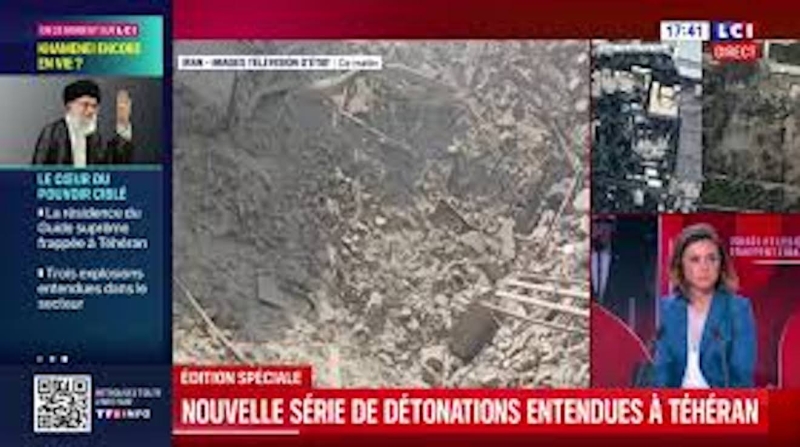
Israel Iran Strikes
Source: LCP Tv Caption
Source: LCP Tv Caption
By killing Ali Khamenei, the strike has opened a succession crisis at the very top of the Islamic Republic. A transitional triumvirate – including President Massoud Pezeshkian, judiciary chief Gholamhossein Mohseni Ejei and cleric Alireza Arafi – has been tasked with managing day to day affairs, but no one can yet predict how power will be redistributed among factions, the Revolutionary Guards and religious authorities. For Israel, which has long portrayed Khamenei as the main ideologue of its destruction, the operation is presented as a form of “justice.” For the United States, the White House insists that the goal is not regime change but the protection of American troops and interests after years of attacks by Iranian backed groups.
From a European perspective, the strategic questions are more complicated. Removing Khamenei may weaken the most hard line elements of the Iranian system, but it could also radicalise others or create a vacuum filled by factions even less inclined to compromise. And whatever the internal outcome in Iran, the strikes have not eliminated the fundamental issues identified by Emmanuel Macron in his first Defence Council: the nuclear programme, ballistic activities and the network of regional militias and partners that make Iran a central actor in almost every Middle Eastern crisis.
From a European perspective, the strategic questions are more complicated. Removing Khamenei may weaken the most hard line elements of the Iranian system, but it could also radicalise others or create a vacuum filled by factions even less inclined to compromise. And whatever the internal outcome in Iran, the strikes have not eliminated the fundamental issues identified by Emmanuel Macron in his first Defence Council: the nuclear programme, ballistic activities and the network of regional militias and partners that make Iran a central actor in almost every Middle Eastern crisis.
PRESIDENT TRUMP’S FOUR WEEK WAR AND THE FIRST U.S. CASUALTIES
As the second Defence Council convenes in Paris, Washington is already counting its first losses in what looks increasingly like a real war, not a limited operation. The Pentagon has confirmed that three US service members were killed and others wounded in a strike on a base in Kuwait used to support operations against Iran. In a series of statements to American media, President Trump has warned that “we expect casualties” and said that operations against Iran could last “about four weeks, maybe less, but we are prepared to go the distance.” He has framed the campaign as both a response to years of Iranian aggression and a necessary show of strength for the United States and its allies.
As the second Defence Council convenes in Paris, Washington is already counting its first losses in what looks increasingly like a real war, not a limited operation. The Pentagon has confirmed that three US service members were killed and others wounded in a strike on a base in Kuwait used to support operations against Iran. In a series of statements to American media, President Trump has warned that “we expect casualties” and said that operations against Iran could last “about four weeks, maybe less, but we are prepared to go the distance.” He has framed the campaign as both a response to years of Iranian aggression and a necessary show of strength for the United States and its allies.
This rhetoric has immediate implications for Europe and for France. If the American president publicly anticipates a conflict of several weeks, with likely additional casualties, regional partners and NATO allies must plan for a protracted period of volatility: attacks on shipping lanes, cyber operations, strikes by proxy groups and the risk of miscalculation between major powers. For Emmanuel Macron, who has repeatedly argued that “no one can think that the question of Iran’s nuclear programme, its ballistic activities and regional destabilisation will be resolved simply by airstrikes,” Trump’s language confirms that the military track can easily take on a logic of its own.
In this context, the second Defence and National Security Council in Paris is not just a technical meeting. It is an attempt to keep a French and European compass in a crisis that is being driven, day after day, by decisions taken in Washington, Jerusalem and Tehran. France must simultaneously protect its nationals, defend its bases and diplomatic missions, preserve the security of its own territory and keep a minimal diplomatic channel open at the United Nations, while domestic political actors begin to demand more transparency and influence over choices that could shape the continent’s security for years to come.
For now, one thing is certain: this is no longer just a night of “targeted strikes” but the opening phase of a real confrontation between Israel, Iran and the United States, with Europe trying to protect its citizens and keep a diplomatic channel alive. In the coming days, we will keep following how this evolving war reshapes the regional balance of power, tests France’s crisis management toolbox and forces European leaders to choose between solidarity with Washington and the need to prevent yet another long Middle Eastern conflict from spiralling out of control...To be continued.../
Liability for this article lies with the author, who also holds the copyright. Editorial content from USPA may be quoted on other websites as long as the quote comprises no more than 5% of the entire text, is marked as such and the source is named (via hyperlink).