
Politics
FRANCE ACTIVATES ORSAN PLAN AS GOVERNMENT COMMUNICATION HEAT UP
HEATWAVE EMERGENCY, NO SALE OF ALCOHOL
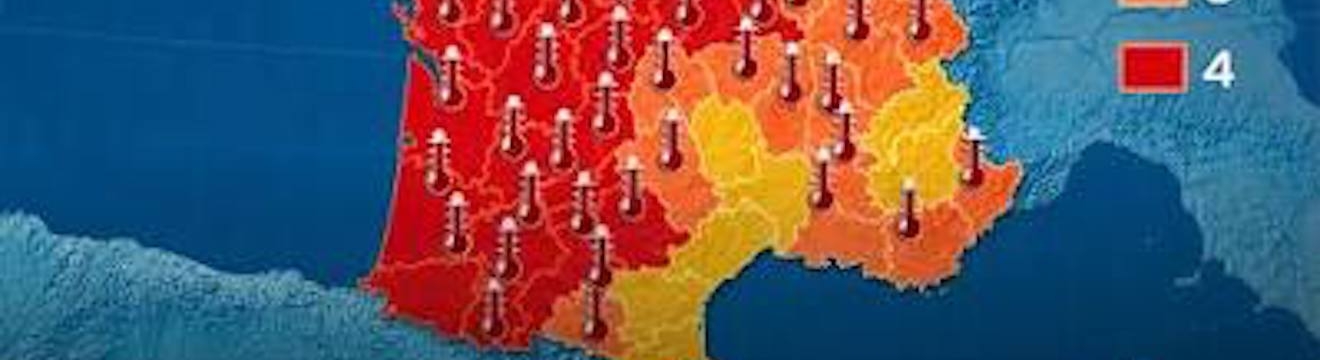
French Map temperature 25th june 26 (Source: Meteo France)
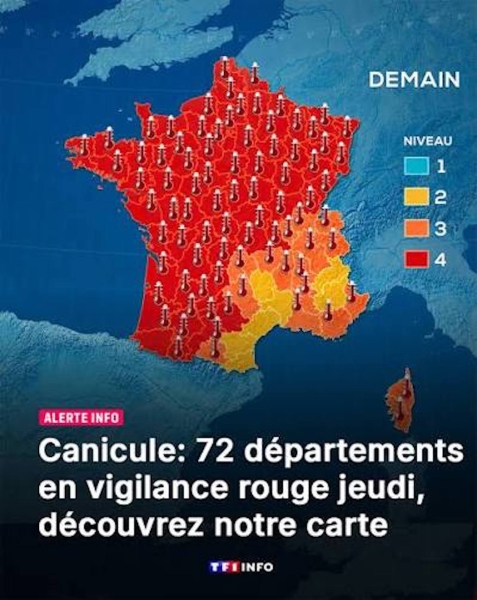
French map temperatures/heatwave
(Source: Meteo France)
(Source: Meteo France)
Yet the official narrative clashes with a simple reality: hospitals are already under strain, real-time mortality figures are not communicated, and the most fragile citizens, including elderly and people with disabilities are barely visible in public discourse. The heatwave is not only a climatic stress test; it is a stress test for political credibility. One silence is particularly striking. Stephanie Rist is not only Minister of Health; her full title is Minister for Health, Families, Autonomy and Persons with Disabilities. Yet in her public communication on the heatwave, she has never explicitly mentioned people with disabilities...
THE ORSAN PLAN AND MINISTERIAL RHETORIC
The activation of the ORSAN plan at level 3 is supposed to signal a “general mobilisation” of the health system. It allows hospitals to trigger local emergency protocols, reorganize services, postpone non?urgent operations and, if needed, recall staff. Health Minister Stephanie Rist insists that the tools are ready and that authorities anticipated a surge in emergency visits and calls to the Samu ( French Paramedic Emergency Service, call the 15 or 18) five to ten days after the start of the heat episode.
But when pressed on the number of deaths directly linked to the heatwave, the minister deflects, saying that figures will only be available at the end of the year. For now, the only official toll repeatedly highlighted concerns drownings, 43 deaths attributed to hydrocution or inability to swim, announced by the Prime Minister. The absence of data on heat?related deaths, especially among seniors, chronically ill people and citizens with disabilities, feeds a growing sense of opacity.
The activation of the ORSAN plan at level 3 is supposed to signal a “general mobilisation” of the health system. It allows hospitals to trigger local emergency protocols, reorganize services, postpone non?urgent operations and, if needed, recall staff. Health Minister Stephanie Rist insists that the tools are ready and that authorities anticipated a surge in emergency visits and calls to the Samu ( French Paramedic Emergency Service, call the 15 or 18) five to ten days after the start of the heat episode.
But when pressed on the number of deaths directly linked to the heatwave, the minister deflects, saying that figures will only be available at the end of the year. For now, the only official toll repeatedly highlighted concerns drownings, 43 deaths attributed to hydrocution or inability to swim, announced by the Prime Minister. The absence of data on heat?related deaths, especially among seniors, chronically ill people and citizens with disabilities, feeds a growing sense of opacity.
A MINISTER FOR DISABILITY WHO DOESN’T NAME DISABILITY
Health Minister Stephanie Rist (Former MP of Loiret) holds a long title: Minister for Health, Families, Autonomy and Persons with Disabilities. Yet in her public statements on the dramatic heatwave, as she answered to our Press microphones today, she speaks of “isolated, precarious and elderly people” without explicitly mentioning people with disabilities, who account for around 17% of the population and often face acute risks during extreme heat. For many activists and observers, this omission is not a detail but a symptom.
In a moment when the country is told that “no one will be left behind”, failing to name people with disabilities, whose survival can depend on access to cooling, electricity, assistance and adapted housing, sends a troubling signal. It suggests that, once again, those who are most dependent on public policies and solidarity are the last to be considered in crisis communication.
Health Minister Stephanie Rist (Former MP of Loiret) holds a long title: Minister for Health, Families, Autonomy and Persons with Disabilities. Yet in her public statements on the dramatic heatwave, as she answered to our Press microphones today, she speaks of “isolated, precarious and elderly people” without explicitly mentioning people with disabilities, who account for around 17% of the population and often face acute risks during extreme heat. For many activists and observers, this omission is not a detail but a symptom.
In a moment when the country is told that “no one will be left behind”, failing to name people with disabilities, whose survival can depend on access to cooling, electricity, assistance and adapted housing, sends a troubling signal. It suggests that, once again, those who are most dependent on public policies and solidarity are the last to be considered in crisis communication.
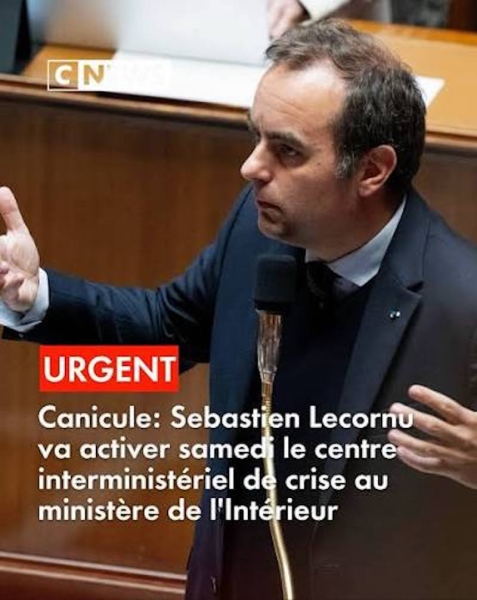
French Prime Minister Lecornu/ Heatwave
Source: French Government
Source: French Government
UNFINISHED ADAPTATION AND URBAN “OVENS” INCAPABLE OF FACING THE HEATWAVE
Beyond emergency plans, the heatwave reveals the unfinished work of climate adaptation. Energy?inefficient housing has turned into dangerous “ovens”, especially in dense urban areas and poorly renovated buildings. Despite repeated warnings from climate scientists and the IPCC, and despite the creation of ministries for ecological transition Mathieu Lefebvre and his fellow Minister for housing Vincent Jambrin, large?scale renovation and urban planning reforms remain incomplete, showing how disconnected they can be from their politician speeches and reality they are facing now as the heatwave installed itself nationwide for over nine days restlessly.
Beyond emergency plans, the heatwave reveals the unfinished work of climate adaptation. Energy?inefficient housing has turned into dangerous “ovens”, especially in dense urban areas and poorly renovated buildings. Despite repeated warnings from climate scientists and the IPCC, and despite the creation of ministries for ecological transition Mathieu Lefebvre and his fellow Minister for housing Vincent Jambrin, large?scale renovation and urban planning reforms remain incomplete, showing how disconnected they can be from their politician speeches and reality they are facing now as the heatwave installed itself nationwide for over nine days restlessly.
While the government highlights investments in hospitals and local infrastructures since 2003, daily life tells another story: blackout prone grids, failing cooling systems, schools and hospitals without proper air-conditioning, and residents in “thermal sieves” left to improvise survival strategies. Once again, those with the least resources, the elderly, precarious workers, people with disabilities , bear the highest cost. Indeed heatwave took lives to 15, 000 people mostly elderly vulnerable and shamefully abandoned by their grown up children, who wouldn't dare leave from their vacations place to get back home and protect, are or even burry their parents...
Between the official talk of “general mobilisation” and the lived experience of this historic heatwave lies a gap that words alone cannot bridge. Activating the ORSAN plan, calling for solidarity and asking ministers to stay in France may send political signals, but they do not replace concrete, structural protection for those most at risk.
If France is to avoid reliving the tragedies of 2003 under even higher temperatures, it will need more than emergency rhetoric: transparency on mortality, explicit inclusion of people with disabilities, massive adaptation of housing and infrastructure, and a political culture that measures success not by communication, but by the number of lives quietly saved....To be continued
If France is to avoid reliving the tragedies of 2003 under even higher temperatures, it will need more than emergency rhetoric: transparency on mortality, explicit inclusion of people with disabilities, massive adaptation of housing and infrastructure, and a political culture that measures success not by communication, but by the number of lives quietly saved....To be continued
With record temperatures, saturated hospitals and rising public anger, the French government has activated its highest health emergency plan called ORSAN , " WHite Plan" addressing the (nearly) 3000 French Hospitals and medical sector. Behind the display of “general mobilization”, communication from the top reveals gaps, blind spots and political panic. The French government announced the ban pp consuming alcohol form tomorrow Friday 26 June at noon and ban of selling alcoholic drinks from 6pm.
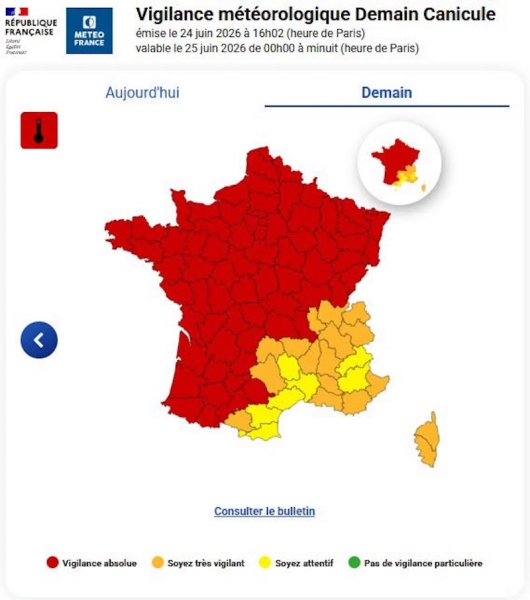
Heatwave Safety Measures communication campaign
Source: French Government
Source: French Government
Liability for this article lies with the author, who also holds the copyright. Editorial content from USPA may be quoted on other websites as long as the quote comprises no more than 5% of the entire text, is marked as such and the source is named (via hyperlink).